
Coming Together Through Collage With London Youth Groups

When did a youth group last make something together with their actual hands, rather than the same six inches of screen? If you're struggling to remember, that's not on you, it's on the last decade. Between 2010 and 2024, 81 youth centres closed across London, and youth service funding fell in real terms by 70% between 2010/11 and 2018/19, according to the YMCA's Out of Service report. That's a lot of rooms that used to exist and now don't, a lot of Tuesday evenings with nowhere in particular to be.
None of that is easy to sit with. But it's also not a problem any one organisation has to solve alone, and there's something genuinely hopeful on the horizon: the Mayor of London has committed £30 million to a "Youth Lates" programme, roughly £1 million per borough across all 32 boroughs, funding late-night youth clubs opening later this year. Money alone won't fill a room, though, someone still has to turn up with something worth doing, and that's where boroughs and community organisations pairing up with people who already know how to make a room full of teenagers want to be there really counts.
Why collage, specifically
There's a reason this isn't a piece about pottery, or drama, or a five-a-side tournament. Most activities pitched at young people ask for something first, confidence, a working body, a willingness to be watched. Collage doesn't. There's no technique to get wrong and no drawing ability required, nothing that separates the "good at art" kids from everyone else in the room. You cut, you arrange, you stick. That's the whole skill, and everyone already has it.
It's also one of the few things left that's entirely screen-free and properly tactile. Paper has texture. Glue is slightly annoying in a satisfying way. You're moving physical things around, making small decisions constantly, a different kind of attention to the passive scroll most teenagers default to. For a generation whose downtime is a device, an hour of hands-in-the-materials, low-stakes making is doing something most other youth activities aren't even attempting.
What making together looked like
A youth leader from a church in London came along to one of our community sessions himself, as a participant, and left slightly stunned by how safe he'd felt just to play, no agenda, nothing to get right, no grading, nothing he had to produce. He asked if we could run the same thing, not a watered-down youth version, for his group at the church. So we didn't build a youth template and hand it over. We built the session around what he'd actually felt in that room, and tried to hand his group the same permission to just play that he'd been given.
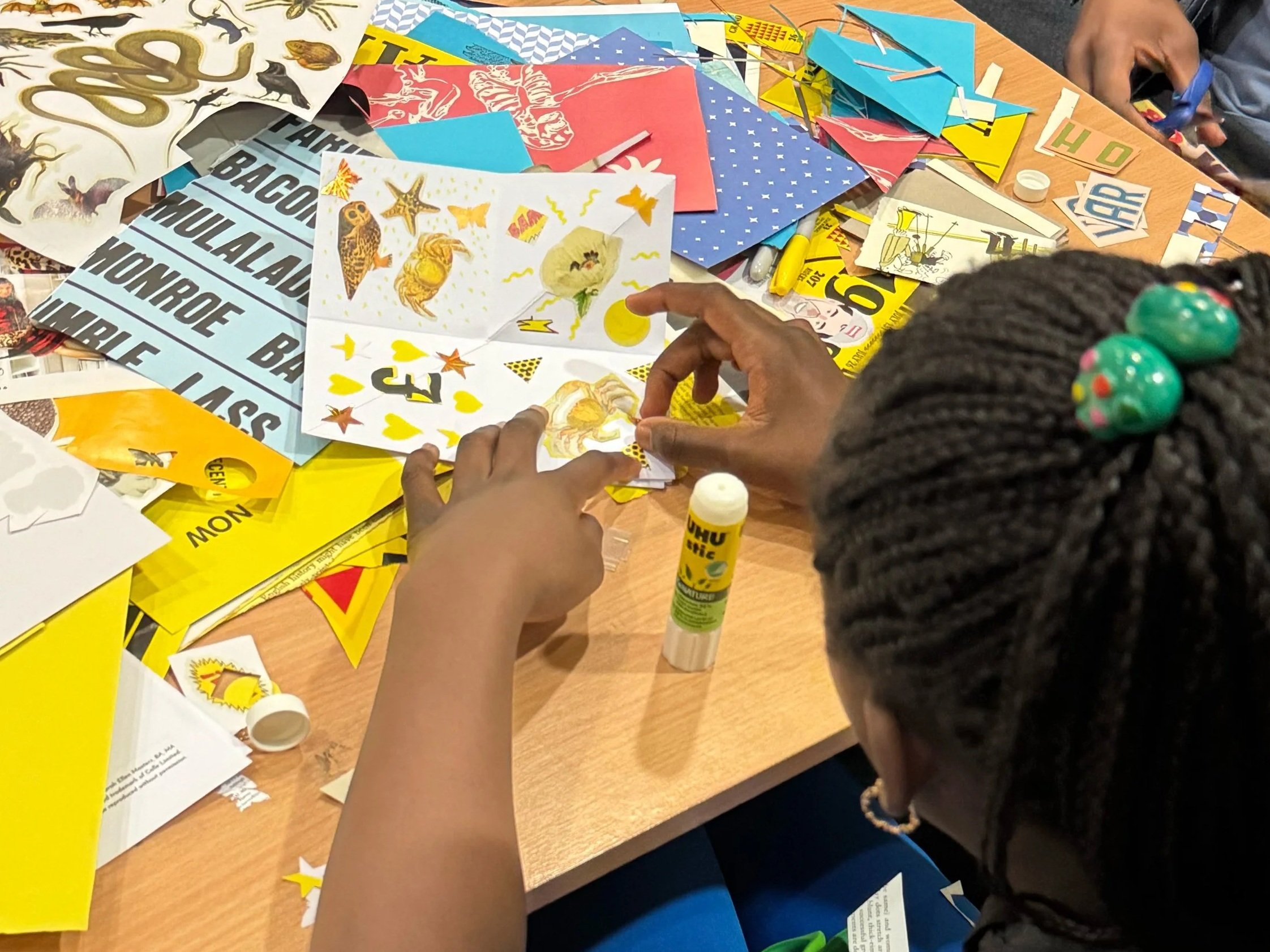
Hands sorting through paper. Materials mid-shuffle. Finished and unfinished pieces laid out at the end, and above all of it, a room full of smiling faces when everyone looked up from the making. That's the whole story of the room: less performed enthusiasm, more the slightly messy, very satisfying business of turning scraps into something nobody could have planned, with your hands, not a touchscreen.
The shape was the one we use for every session: a short, warm briefing that makes clear this is a place for exploration, not grading; curated materials, so nobody has to prep anything; time to make at whatever pace the group set; and a reveal at the end, the good kind of chaos where everyone's in it together.

Why Sarah, why Collé
Sarah, who runs every Collé session, is dyslexic, and for a long time she saw her own creativity as something to work around rather than lean into. Collé grew out of her own postgraduate research, documenting her collage practice and what it actually did to her creative wellbeing, sense of self and confidence. "Collage practice changed how I saw my own mind entirely," she says. It sidesteps the channels a lot of people find hardest under pressure, reading, spelling, speaking fluently while being watched, which is why every session is built low-verbal, with no blank page, only fragments already laid out to respond to. Not as a nice-to-have for the quieter kid in the room, but because Sarah built it for a mind that's ever been told it's too scattered or too slow, hers included. As she puts it: "Every mind thinks differently, yours included. That's not a problem to fix. It's a power to unlock." That's the actual difference between booking a generic art activity and booking Collé.
For whoever's organising, it's a gentle one to bring in, too: no kit to source, no long lead-in, no facilitator to train up. Just something you can invite a room of your young people into, and watch them get properly absorbed in it.
If boroughs and community groups are about to be looking for exactly this kind of warm, high-payoff activity, we'd love to hear from whoever else is already trying to solve this, and figure it out together.
Fancy making something together?
If you're running a youth group, a church, a charity, a borough-funded club, wherever and you like the sound of a room full of people making something with their hands instead of scrolling through something on a screen, let's talk.
Get in touch: hello@colle.uk
Tell us about your group. We'll work out the rest together.
